|
Divider Friday, 20 November 2009  What is a Divider? - A divider is a mathematical instrument (also known as drafting or cartographic instrument), which is used to measure length of any irregular lines and distances on map or charts. Name the parts. - It consists of three parts; a handle, a pivot and spikes. It is mainly made of steel excluding the handle, which is made of plastic. Uses of each part. - The handle is used to hold the whole divider, whereas the pivot is used to join the handle and the spikes together. Meanwhile, the spikes are used to hold itself on place for taking measurement. How to use? - There are 2 ways to use the Divider: 1st - Hold the divider on the line to be measured. - Drag slowly towards the end. Hold firmly. - Take a ruler; place the divider on the scales. - The measurement can be obtained by reading on the ruler’s scales. 2nd - Set an ideal scale on the divider. Example: 2 cm = 1 step - Hold the divider on the line to be measured. - Drag slowly, step by steps towards the end. Hold firmly. - Count the number of steps as its measurement. Example: 5 steps = 2 x 5 = 10 cm Done by: Asrinnatul Najiah & Awg. Md. Azri Hacksaw Thursday, 19 November 2009  A hacksaw is a tool used for cutting metal and other material such as wood, plastic, etc. There are many types of hacksaw vary in weight and uses. Examples are: Deep-throat hacksaw which is used to cut the width of pipes. The hacksaw consists of 5 parts: 1. The handle is a metal arc which is attached to a narrow disposable blade. 2. The frame is used to connect the handle and the blade. 3. The blade is interchangeable and consists of 18 to 32 teeth. It can cut the hard and tougher material. 4. The pin is used to preserve the alignment when tension is put on it. 5. The sleeve is used to prevent the anchorage from turning. How to use? · Firstly, grip the handle tightly. · Secondly, put the blade on the area which is going to be cut. Put the blade perpendicular (90 ˚ angle) on the object. · Thirdly, push and pull the hacksaw repeatedly to cut the object. · Finally, repeat the third step until the object is completely cut into half. Pliers  Definition: -it is a tool. -use for holding, bending or cutting wires There are types of pliers, 1. flat nose plier 2. side cutting plier 3. combination plier It is made of special steel and drop forged for added strength. It is resistance to brittleness. It consists of 2 parts: 1. handle 2.jaws The plier is adjustable for holding different sizes of work. The jaw consists of 2 types: 1. flat jaw - it is flat surface and use for holding and forming work 2.curved groove (serration) jaw - is used for forming and holding work. There is a nut to holds the pliers together. How to use it? First, gripped the handle so the pliers don't slip while we holding it. Next, if we want to cut the wire, we gripped the wire with the flat part of jaws and groove at the back which is used for cutting it. The serrated part of jaw is actually to loosen or tighten a nut. We also can strip the rubber insulator off the cable by using the same part. Try Square Wednesday, 18 November 2009  Definition: Try square is an instrument and a tool which is use to test right angle.Parts: Blade & Stock Description of each part: - Blade is made from hardened and tempered steel which is 8 inches long at right angle to the stock - The stock made from rosewood and faced with brass to preserve the wood from damage How to use: - To act as a guide in laying out lines across the grain - To test the edges or end of a board to see if they make right angle or are square with the faces DONE BY: MAISARAH & AMRIL AMIN Inside caliper Tuesday, 17 November 2009  Description- it is an instrument used to measure the inner diameter of an object. Parts- it is divided into 5 parts. Handle, pivot, screw and two legs with each foot out bended.. Uses of each each parts- handle is for holding the inside caliper. Pivot is for adjusting the tightness or looseness of the legs. Screw is for adjusting the wideness of the legs. Out bended feet are for measuring the inner diameter of an object. How to use? Firstly, insert the inside caliper into the object that diameter is to be measured. Secondly,carefully adjust the screw so that the out bended feet on the legs fit the object. Thirdly, after fitting he object. Take the inside calipers out and measure the length of the out bended feet. Measurement could be read by using a ruler. But. However, while measuring the length of the out bended feet. Remember to always start measuring from the tip point of the left out bended feet to the tip point right out bended feet. By this you will have an accurate reading on the measurement done.  Done by: Lee Chao Jeng and Wan Mohammad Juwaidi Bin Wan Julaini. PND ICE 09/10 Morphy caliper Monday, 16 November 2009 Definition: Instrument -to scribe a line at a specific distance between two points from a flat or curved surface. Size and shape -It has bent leg and at the other end has a scriber Parts -Scriber,Pivot and Bent leg  Scriber -use to make its mark of a predetemined distance,this ensures a line parallel to the edge -can be adjusted for wear and can be replaced when excessively worn. Pivot -to mount on attach by or provide with a pivot.To cause to rotate,revolve or turn. Bent leg - used to run along the workpiece edge. How to use? -first,hold the pivot to set the distance. -the bent leg is place at the curved surface or flat surface. -the scriber is use to scribe a line This is to ensures the line is in paralel. Done by : Md Astrie and syazana Ibrahim Description of object - Claw Hammer Claw Hammer  Definition, - A commonly used tool, either at home or workshop. - A hammer with a cleft at the end (claw). - Used for hammering and pulling nails. Parts and function, Two main parts; Head and Handle. 1) Head (made of metal) - Face – to hammer nails. - Claw – to extract nails. - Neck – where the head and the handle is connected. 2) Handle (made of wood (common) or fiberglass/steel) - To hold the hammer How to use Claw hammer? • How to use the Claw?  1) First, grab a claw hammer, hold the handle upright. 2) Force the claw under the nail’s head and start extracting. 3) To protect the surface, put a putty knife or scraper blade. 4) After the nail is extracted half way, put a block of wood under the head of the hammer to increase the leverage. • How to use the Face? 1) First grab a claw hammer, hold the handle upright. 2) Hold a nail with other hand onto workpiece. 3) Hit the nail’s base with the hammer’s head. 4) Once the nail is half way deep, remove your hand and hammer the nail until it is completely through. - Nur'aqirah Mumin & Mohd. Abd. Latif Hj. Pardi Scriber. Sunday, 15 November 2009  Scriber Types:
Main parts: 2 parts:-
Description of each parts:- The handle: It is used to hold and move the tool. nickel plated. The Pointer: It is used for making lines on the work piece. Silver steel pin. How to use?
Group: Nurliyana Halim and Abdul Afiq Junaidi of PNDICE. Labels: Descriptions♥, scriber Micrometer  Definition: -is an instrument -use to measure small distances Parts of micrometer -anvil -spindle -lock nut -frame -thimble -ratchet Description of the parts -Spindle and anvil face: Glass hard and optically flat. Also made with tungsten carbide faces. -Spindle: made of alloy steel. -Lock nut: Effective in any position. Spindle retained in perfect alignment. -Sleeve: Made of Pearl chrome plated. Accurately divided and marked. Adjustable for zero setting. -Thimble: Made of pearl chrome plated. Accurately divided. clearly numbered in ever fifth graduation. -Frame: sturdy U-shaped frame. How to use it: 1. place the object that we want to measure between the anvil and spindle rods. 2. turn the sleeve to close the rods around the object to be measured. The rods should lightly touch the object between them but not clamp down on it. 3. Flip the lock nut to lock the spindle from moving. 4. Read the value at the thimble which in millimeters. 5. Read the value at the sleeve which in millimeters 6. Add these values together and the total of those values is the measurement of the object between the rods. A VERNIER CALIPERS Saturday, 14 November 2009 Aloha there ICE~ Here's the description of Vernier Calipers. 
The above is a picture of Vernier Calipers. (kindly refer this picture for Parts of the Vernier Calipers. TQ♥) >>INTRODUCTION<<
A Vernier caliper is an instrument.
Used to measure:
It is made up of stainless steel.
Vernier calipers is commonly used in industry provide a precision to a hundreth of milimeter (10 micrometers), or one thousandth of an inch more precise instrument used for the same purpose is the micrometer.
>>PARTS OF THE VERNIER CALIPERS<<
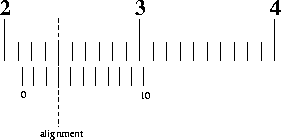
1. Outside jaws: used to measure external diameter or width of an object. 2. Inside jaws: used to measure internal diameter of an object. 3. Depth probe: used to measure depths of an object or a hole. 4. Main scale: gives measurements of up to one decimal place(in cm). 5. Main scale: gives measurements in fraction(in inch). 6. Vernier gives measurements up to two decimal places(in cm). 7. Vernier gives measurements in fraction(in inch). 8. Retainer: used to block movable part to allow the easy transferring a measurement.
>>THE INSTRUCTION ON USE<<
*Since the instruction for this instrument is quite long to elaborate, you might have a problem in understanding it so i suggest that you click to the links that i have mentioned below. Plus, it's more easier for you to understand because there's a demonstrations been played there..okay?*
(Don't be so lazy to click on it guys!!it won't take you an hour to do it!HAH!)
You can click to the link below:
Click and
Ok..i think that's all for now..if you have any questions regarding on this descriptions..please don't be hesitate to confront me or Faiz. Okay? 
I'm sleepy..time for bed♥
Goodnight & Sweetdreams Eyespotters♥ Compiled by: ♥Venney S.S ♥ & ♥M.Faiz M.A ♥ Labels: Descriptions♥ ASSIGN- DESCRIPTION So, our first discussion is about our latest assignment; DESCRIPTION. Eyespotters, do post up your points here for every each group you belong to. Benefits? less time consuming & no paper required. (in addition, we save TREES!)hehehe. How to do? Well, Just copy and paste your work here, then WALAA! :D I hope this helps. ^^ Sincerely, Leeyan / TS02 Labels: Description HELLO. First. Assalamualaikum and hello dear eyespotters, I believed you guys already received the email regarding the log in access password to this blog from Hafiz. (If you haven't, kindly check your email at Facebook.) You can also add your own email address through 'settings', if you want to. Any changes made are allowed, so feel free to beautify up this place! :) Thankyou. Sincerely, Leeyan Halim / TSO2 Labels: Opening |
INTRO We're ONE in HEART.
Profile EyeSpotters! Typical students from PND ICE group. Also known as the ICE BABIES. :D Officers: Ziana Binti Haji Mahmud (Supervisor) Chao Jeng (PA) Hafizz Bakar (Secretary) Afiq Albino (TSO 01) Lianna Halim (TSO 02) Bunga Bby Chowder (Treasurer) Admins: Shenzou Amakuza Venney Suzana Asrinnatul Najiah Prince Azri Latiif MLHP Yunus Wan Juwaidi AchieZz NhzYunus Ayu Mumin Adekz Devilz Sarah Rusyde Fae Dorian Syukri Amal Lina Nabihah Meng Karimah Bab Hafidzul Tagboard scream it out loud Traffic Traffics Affiliates you're on your way Archive gone with the wind » November 2009 » December 2009 » January 2010 » March 2010 » June 2010 Credits take a big bow Cbox: Ayu Qirah Mumin. Layout : Janani. Background : Photobucket. | |